Patient Questions That Make Great YouTube Shorts for Doctors
Turn repeated patient questions into clear, privacy-safe Shorts that teach one useful idea and lead viewers to fuller context.
You already answer these questions. The work is turning them into Shorts without turning them into medical advice.
Patient Questions That Make Great YouTube Shorts for Doctors
The best Shorts for doctors are often hiding in plain sight. They show up in the questions patients ask over and over, the clarifications you give at the end of a visit, and the teaching moments inside longer recordings.
That is what makes this topic practical. You do not need to invent a new content angle every week. You need a repeatable way to spot questions that are broad enough to share, useful enough to matter, and simple enough to fit into one Short.
The goal is not to turn every question into a clip. The goal is to turn the right questions into a Short that teaches one clear idea and leaves room for full context.
What makes a patient question work well on camera
A good Short starts with a question that many viewers would recognize immediately.
That question usually has three qualities:
- it comes up often in your practice or teaching
- it can be answered in one focused point
- it does not depend on a private story to make sense
Questions with those traits are easier to publish because they already sound like public education, not a one-off consultation.
A question can also work well when it opens the door to a larger lesson. In that case, the Short is not trying to be the whole explanation. It is giving viewers the first useful step.
Start with the public version of the question
When a patient asks something privately, the exact wording is not always the right wording for a public Short.
The public version should be broader, cleaner, and easier to understand without personal details. For example, instead of carrying over a very specific case, you can frame the topic around the general question behind it.
That matters because viewers on YouTube are not hearing the follow-up conversation you had in the room. They only hear the Short. If the question only makes sense with the private context attached, it is not ready yet.
A useful filter before you clip
Before you publish a question-based Short, check three things:
- Can the topic stand on its own?
- Can the answer stay general?
- Would a viewer still understand the point without the original conversation?
If the answer to any of those is no, reframe the topic or choose a different moment.
A strong doctor Short answers the public version of the topic, not the private version.
Topics that usually clip well
Some teaching topics are naturally better suited to Shorts than others.
You will usually get better results from moments that define a concept, compare two ideas, correct a common misunderstanding, or give one clear takeaway from a longer lesson. Those formats are easier to explain quickly and easier for a viewer to remember later.
Topic shapes that often work
- What does this term mean in simple language?
- How does one idea differ from another?
- What is the common misconception?
- What is the clearest takeaway from this lesson?
- What is the first useful point to explain?
These are not scripts. They are shapes. Once you know the shape, you can turn a long answer into a Short that feels complete.
Topics that often need more context
Some topics are harder to use because they depend on a full history or a careful exam. Those can still be useful for education, but they usually need tighter framing so the viewer understands the boundary of the lesson.
If the topic is too specific, the Short can sound confident while actually being incomplete. That is a bad trade.
How to frame the answer without sounding like a disclaimer
Doctors often know how to be careful. The challenge is making that care feel useful on a phone screen.
A good Short does not bury the answer under caveats. It gives the answer first, then adds the boundary in plain language.
A simple answer structure
You can usually build the Short like this:
- state the topic
- answer the main point
- add one line of context
- point viewers to fuller context if needed
That structure keeps the clip moving. It also helps the viewer hear the main lesson before the nuance arrives.
If the nuance is doing all the work, the answer is not yet clear enough for a Short.
What to avoid
Avoid framing that makes every answer sound uncertain from the start. Phrases that hedge too much can make the clip feel muddy, even when the underlying teaching is strong.
Clarity is not the same thing as overclaiming. A Short can be direct and still stay inside your professional scope.
Where Minti Studio helps
Minti Studio is built for turning long videos into Shorts, which is useful when your best answers already live inside lectures, webinars, interviews, or Q&A recordings.
You can paste a YouTube link or upload a file, then use transcript-based clip selection to jump to the part where the teaching point gets explained. That helps you find the moment faster, and it keeps you focused on the lesson rather than the timeline.
If the recording is horizontal, Minti Studio can reframe it to vertical so the Short fits YouTube Shorts and Instagram Reels. Caption style templates help you keep the answer readable on a phone screen, and scheduling helps you move reviewed clips into a steady publishing routine.
For busy doctors who have recordings but no time to run a clipping workflow, Autopilot prepares, captions, and schedules Shorts from your long videos, and you can change or remove any Short before it goes live.
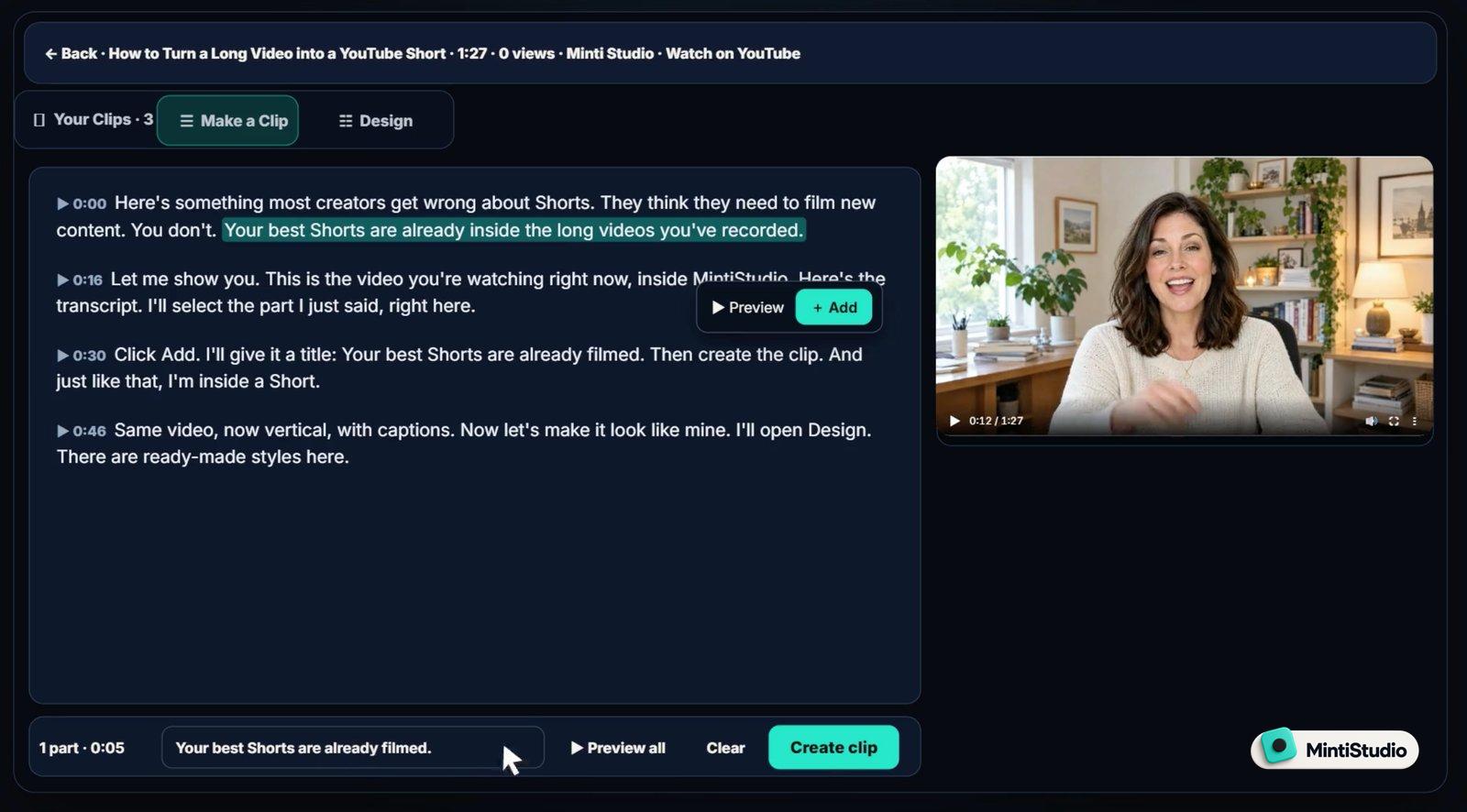 Screenshot from Minti Studio
A simple workflow for question-based Shorts
You do not need a complicated production system. You need one that lets you move from topic to published Short without losing the teaching point.
Step one: collect repeated topics
Keep a running list of the recurring teaching ideas that show up in comments, live sessions, consults, and teaching conversations.
You are looking for repetition. If the same idea keeps coming back, it is probably a strong Short topic. Capture it as a de-identified, general topic idea rather than copying private consultation language.
Step two: choose the clearest answer
Not every answer deserves a Short. Pick the version that is easiest to state in one focused idea.
If the answer needs a long backstory, it may belong in a full video first, with the Short acting as the entry point.
Step three: remove anything too private
A public Short should not rely on patient-identifying detail.
Keep the clip centered on the general teaching point, not on the person or the individual case behind it.
Step four: make the clip readable on a phone
A Short can have a great answer and still fail if the captions are hard to read or the framing is distracting.
This is where vertical formatting and clean captions matter. The viewer should be able to follow the answer quickly, even if they are watching with sound off.
Step five: schedule after review
Publishing should come after the privacy and clarity pass, not before it.
Once the clip is clean and the answer is complete, schedule it into a consistent rhythm instead of publishing whenever you happen to finish editing.
Topic formats that are easy to publish
Some topic formats are naturally better for Shorts because they have a tight structure.
Definition topics
These ask what a term means or what a concept actually refers to. They work well because the answer can usually be concise and memorable.
Comparison topics
These ask how two ideas differ. They work well when you can give one clean distinction that helps the viewer understand the choice or the concept.
First-step topics
These ask for the simplest way to begin understanding a topic. They work well because the answer can often be framed as a simple sequence inside a recorded lesson.
Myth-busting topics
These ask you to correct a common misunderstanding. They work well when the correction is direct and the lesson is easy to state in one sentence.
Boundary topics
These ask for the limit of a concept or the point where a lesson needs fuller context. These can be useful teaching moments, but they need especially careful framing so the Short stays general.
Compare a vague Short and a focused Short
A topic-based Short can fail in two very different ways. It can become too broad, or it can become too narrow and private.
Too broad
A broad Short sounds safe, but it often says so little that the viewer cannot tell what the lesson is.
That usually happens when the answer tries to cover every exception at once.
Too narrow
A narrow Short can sound impressive, but it may only make sense inside one specific patient scenario.
That makes the clip hard to reuse and harder for a new viewer to trust as a general lesson.
The best version sits in the middle. It is specific enough to teach and broad enough to share.
How to turn one recording into several Shorts
A single teaching recording often contains more than one useful topic.
One section may define a term. Another may explain a difference. A third may answer the most common follow-up question. That means one source video can produce more than one Short without repeating yourself.
That is especially useful for doctors who already record webinars, Q&As, or educational sessions. Instead of starting from scratch, you can look for the moments where the lesson is explained cleanly and the explanation stands on its own.
A practical selection rule
Choose moments where the answer does not depend on the five minutes before it.
If the clip needs too much setup, keep searching.
If the clip makes sense immediately, it is probably worth reviewing.
Related guides
- YouTube Shorts for Doctors: The Complete Guide
- How Busy Doctors Can Grow a YouTube Channel in One Hour a Week
- Medical Shorts Done Right: Context, Caveats and Patient Privacy
Final CTA
If you already answer questions in longer videos, you do not need a new content system. You need a way to find the best teaching moments and move them into Shorts with less manual work.
Minti Studio can help you turn recorded answers into reviewable Shorts with transcript-based selection, vertical reframing, captions, and scheduling in one workflow. If your bottleneck is time, Autopilot can prepare and schedule the Shorts from your long videos while you keep control over what goes live.
More from the blog
Medical Shorts Done Right: Context, Caveats and Patient Privacy
A practical guide to making medical Shorts clear, cautious, and privacy-safe while keeping the teaching point intact.
How Busy Doctors Can Grow a YouTube Channel in One Hour a Week
A practical weekly workflow for doctors who want a steady YouTube channel without turning content into a second job.