Medical Shorts Done Right: Context, Caveats and Patient Privacy
A practical guide to making medical Shorts clear, cautious, and privacy-safe while keeping the teaching point intact.
You can make a Short feel simple without making it careless.
Medical Shorts Done Right: Context, Caveats and Patient Privacy
Medical Shorts can be useful when they help viewers understand one clear point quickly. The challenge is that medicine rarely fits into a neat, context-free clip. A good Short has to keep the teaching intact while leaving out anything that should not be public.
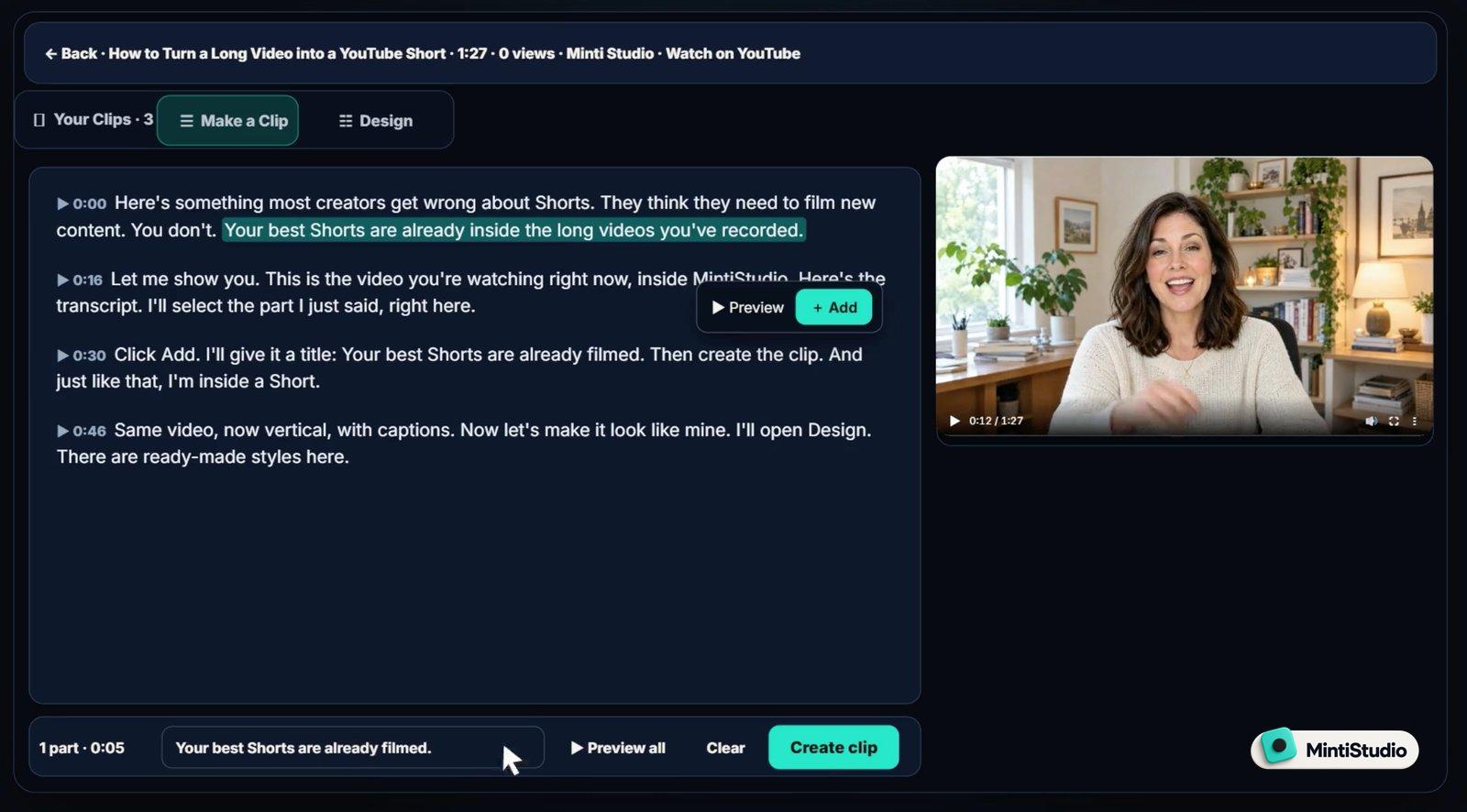 Screenshot from Minti Studio
That means two things at once:
- the clip needs enough context to be understandable
- the clip needs enough restraint to protect privacy and avoid overclaiming
For doctors, the hardest part is often not the filming. It is deciding what can be cut down without turning a careful explanation into something misleading.
This guide shows how to keep context and caveats in the clip, how to review a Short for privacy issues, and how to build a workflow that respects your role as a professional educator.
What a good medical Short is trying to do
A strong medical Short does not try to cover everything. It tries to do one job well.
That job may be to explain a concept, frame a common question, or introduce a teaching point that belongs in a longer video.
The best clips usually have three qualities:
- one main idea that is easy to state
- enough context to make that idea honest
- a clear boundary around what the clip is not saying
When those three pieces are in place, the Short feels useful instead of rushed.
Why context matters more in medical content
In many niches, a clipped sentence can stand alone.
In medicine, a sentence often depends on the surrounding explanation. If the surrounding explanation is removed, the viewer may hear a stronger claim than you intended. That is how a helpful teaching moment turns into a risky public clip.
A Short should not leave the viewer guessing whether the speaker meant a general principle, a specific example, or a narrow exception.
Start with the teaching point, not the clip length
It is tempting to ask, How short can this be?
That is the wrong first question.
A better question is, What is the one point this clip should teach?
If you know the teaching point first, you can decide what background is essential and what background can be removed.
A simple test for the right moment
Before you turn a segment into a Short, ask:
- Does the point make sense on its own?
- Does the viewer need one sentence of setup before the explanation?
- Is there a caveat that changes the meaning of the clip?
- Would a stranger misunderstand this if they saw only this segment?
If the answer to the last question is yes, the clip needs more context or a different moment.
A clear medical Short is not context-free. It is context-aware.
Preserve caveats without burying the viewer
Doctors often know how to add nuance. The problem is that nuance can become so long that the Short loses momentum.
The answer is not to remove the caveat. The answer is to place it where it does the most work.
Keep caveats short and functional
A useful caveat should do one of these things:
- define the scope of the statement
- note that the point is general, not universal
- remind the viewer that individual situations vary
- separate a common teaching point from a special case
That kind of language helps the viewer understand the clip without turning it into a lecture on every exception.
Avoid caveat overload
If a clip contains so many qualifiers that the main point disappears, the Short is not ready yet.
You are not trying to squeeze a whole seminar into a vertical video. You are trying to deliver one honest teaching point with a boundary around it.
A clip should feel careful, not tangled.
Protect patient privacy before you think about captions
Privacy is not a final check you do at the end. It should shape the clip from the start.
If a recording includes patient details, identifiable stories, or sensitive context, the safest workflow is to keep those details out of the public version entirely.
What to remove before publishing
Review the source video for anything that could identify a person indirectly as well as directly. That includes:
- names and initials
- dates and locations that narrow the person too much
- unusual details that make a case recognizable
- screenshots or visual references that reveal private information
- spoken context that would let someone identify the situation
Even when a detail seems small, it can matter once the clip is shared widely.
Why a private detail can survive clipping
A clip editor may trim the obvious parts and still leave enough context for a person to be recognized. That is why review matters.
The question is not only whether a name is spoken. The question is whether the clip still points too directly at one person, one event, or one encounter.
Build a review pass for every Short
Before a medical Short goes live, it should go through a privacy and clarity review. That review does not need to be complicated, but it does need to be consistent.
Review the clip in this order
First, check the teaching point.
Second, check the caveat.
Third, check the privacy risk.
Fourth, check whether the clip still makes sense on a phone screen.
This order matters. If you polish captions before you remove sensitive context, you may waste time styling a clip that should not be published.
What a privacy-safe medical Short usually looks like
A privacy-safe Short is not dull. It is specific enough to be useful and restrained enough to be public.
It usually has:
- a general teaching point rather than a patient story
- language that stays inside your professional scope
- a sentence or two that sets the boundary of the advice
- no personal detail that would help identify someone
That is often enough for a Short to work well while keeping the content professional.
When a generic example is useful
Sometimes a generic example is the clearest way to teach.
If that is the best format, keep it generic and privacy-safe. Use examples that do not rely on patient cases or patient-derived details, so the lesson can stand without exposing any person behind it.
Where Minti Studio helps
Minti Studio is built for turning long videos into Shorts, which makes it useful when your best teaching moments are already recorded.
You can paste a YouTube link or upload a file, then use transcript-based clip selection to find a segment without scrubbing through the whole recording by hand. That helps when your task is locating candidate segments quickly; you still need to review each clip yourself for context and privacy before publishing.
If the source video is horizontal, Minti Studio can reframe it to vertical so the clip fits Shorts and Reels. Caption style templates help you keep the teaching readable on a phone screen, and scheduling helps you move a reviewed clip into a predictable publishing rhythm.
For busy doctors who want less operational work, Autopilot prepares, captions, and schedules Shorts from long videos, and you can change or remove any Short before it goes live.
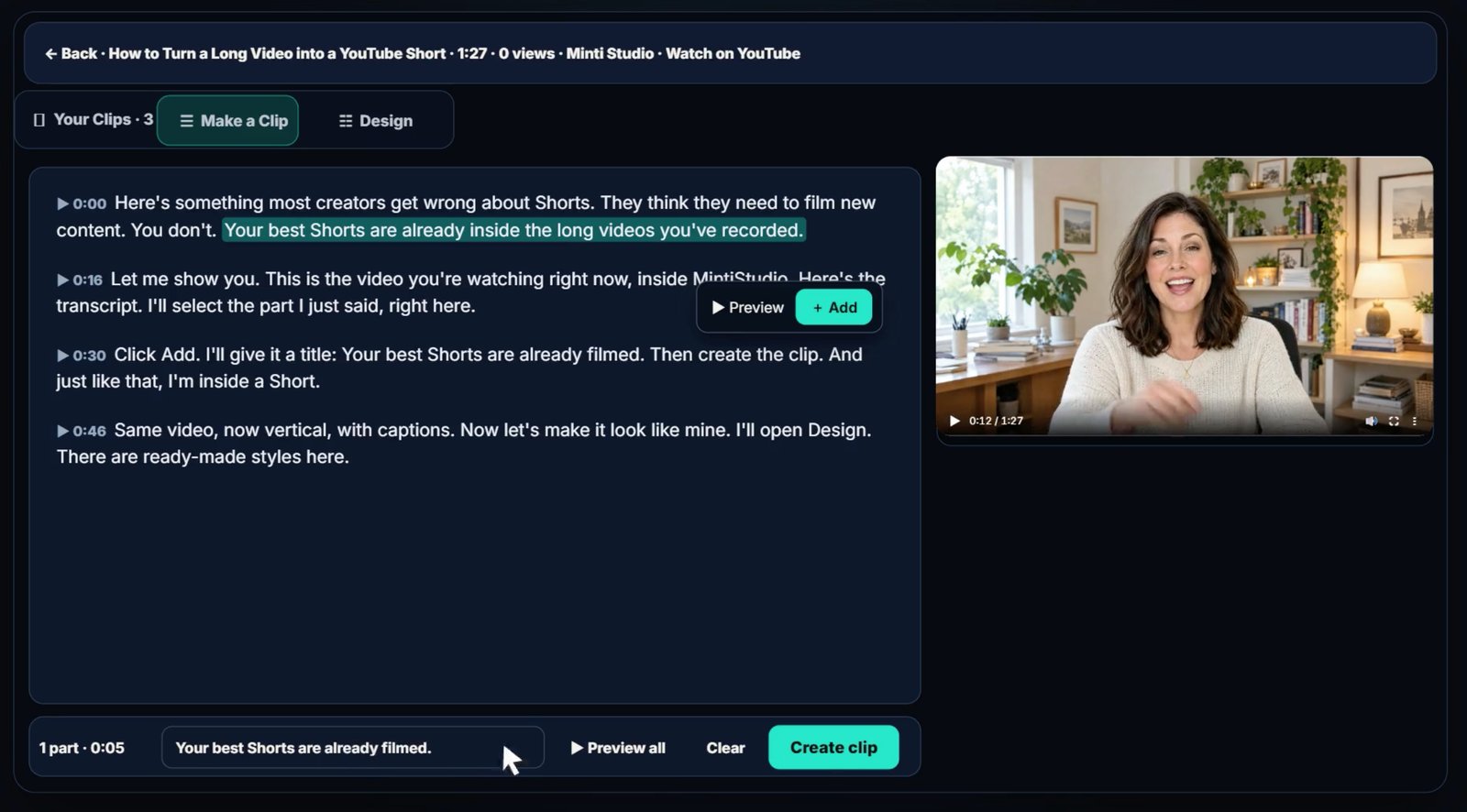 Screenshot from Minti Studio
A simple medical Shorts workflow
A good workflow should make it easier to stay careful, not easier to move fast for its own sake.
Step one: choose a source recording with one clear lesson
Start with a lecture, Q&A, webinar, or teaching session that already contains a focused explanation.
A good source recording has a point that can stand on its own once the surrounding material is removed.
Step two: find the exact segment that carries the lesson
Use the transcript to move straight to the point where the explanation becomes complete.
You are looking for a section that still makes sense after trimming, not just a sentence that sounds good in isolation.
Step three: strip out sensitive detail first
Before you think about captions or layout, remove anything that could expose a patient or imply more than the clip can responsibly say.
If the clean version loses the point, choose a different segment.
Step four: add the caveat where it belongs
A caveat should support the teaching, not bury it.
Place the boundary statement early enough that viewers understand the scope, but keep it brief enough that the main lesson remains the focus.
Step five: check the clip on a phone screen
Medical Shorts are often watched quickly and without sound.
Make sure the captions are readable, the framing supports the speaker, and the clip still feels complete in a vertical format.
Step six: schedule only after the review pass
Publishing should be the final step, not the first.
Once the Short has passed the teaching, caveat, and privacy checks, you can schedule it with more confidence.
 Screenshot from Minti Studio
Compare two common mistakes
Many medical Shorts fail in one of two ways. They either become too vague or too exposed.
Too vague
A clip becomes too vague when the caution is so heavy that the teaching point disappears.
The viewer leaves with a sense that something was said carefully, but not what they were supposed to learn.
Too exposed
A clip becomes too exposed when the lesson is clear but the surrounding details are too specific.
That may feel more complete to the creator, but it can put privacy and professionalism at risk.
The goal is a middle path: clear enough to teach, restrained enough to publish.
Practical review checklist before publishing
Use a consistent checklist before any medical Short goes live.
- Is the main teaching point obvious?
- Does the clip include the minimum context needed to be honest?
- Is the caveat short and useful?
- Did you remove any patient-identifying detail?
- Does the clip still make sense without the full recording?
- Is the vertical version readable on a phone?
If any one of those answers is no, the clip needs another pass.
Related guides
- YouTube Shorts for Doctors: The Complete Guide
- How Busy Doctors Can Grow a YouTube Channel in One Hour a Week
- YouTube Shorts for Consultants: A Practical Workflow for Public Proof Without Sharing Client Confidentials
Final CTA
If your source videos already contain useful teaching, do not start by making them shorter. Start by making them safer and clearer.
Minti Studio can help you move from long recordings to reviewed Shorts with transcript-based selection, vertical reframing, captions, and scheduling in one workflow. If you want a lighter process, Autopilot can prepare and schedule the Shorts from your long videos while you keep control over what goes live.
More from the blog
Patient Questions That Make Great YouTube Shorts for Doctors
Turn repeated patient questions into clear, privacy-safe Shorts that teach one useful idea and lead viewers to fuller context.
How Busy Doctors Can Grow a YouTube Channel in One Hour a Week
A practical weekly workflow for doctors who want a steady YouTube channel without turning content into a second job.