Are Your YouTube Topics Attracting the People Your Offer Can Help?
A practical guide for coaches and educators who want their YouTube topics to attract viewers who could actually buy. Learn how to check topic fit, avoid audience mismatches, and turn aligned long-form teaching into Shorts that support your offer.
Your views are not the main question. Fit is.
If you teach, coach, consult, or sell a service, YouTube can bring in the wrong crowd just as easily as the right one. A topic can be popular, searchable, and even entertaining, yet still miss the people your offer is built to help.
That is why topic selection matters so much for expertise channels. You are not only asking, “Will this video get attention?” You are asking, “Will this topic attract viewers who recognize the problem I solve?”
For a nutrition coach, that difference can be the gap between a channel full of bargain hunters and a channel full of people who care about health, habits, and sustainable change. The same pattern shows up for educators, consultants, and podcasters. If the topic pulls in the wrong curiosity, the channel can grow without moving the business forward.
What topic fit actually means
Topic fit is the match between three things:
- what your viewer wants to solve
- what your paid offer solves
- what your video makes the viewer believe you help with
When those three line up, your content does more than entertain.
It pre-qualifies the audience.
When they do not line up, you can still get views, but the comments, clicks, and inquiries can feel disconnected from your offer.
A useful way to think about this is simple: the topic should attract people who would naturally care about the next step you sell. If the viewer only cares about the surface angle, they may never care about the deeper problem you solve.
A topic can be relevant without being aligned
This is where many channels get stuck.
A topic may sit near your niche without serving your offer. For example, a nutrition coach can make food review videos that attract people who want cheap recommendations. That audience is real, but it is not the same as an audience looking for behavior change, structure, or coaching support.
The content is still about food. The fit is just different.
A useful topic for your channel should make the right viewer think, “This person understands the problem I have.”
Start with the offer, not the broad audience
Before you plan a title, define the people who are most likely to buy from you.
That sounds obvious, but many channels start from what is broadly interesting instead of what is commercially useful.
Ask three questions:
- What problem does my offer solve?
- What kind of viewer already feels that problem?
- What topics would that viewer click without drifting away from the offer?
If your offer helps people lose weight through better habits, then your topics should show that you care about habits, decisions, patterns, and support. If your offer helps people build a business, your topics should show you care about decisions, systems, and results, not just generic inspiration.
The more precise your answer, the easier it becomes to choose topics that bring in the right people.
Use the offer as a filter
A simple filter can help.
Before you publish, ask whether the topic would make sense for a potential client if they saw only the title and thumbnail.
If the answer is yes, the topic is probably close to your offer.
If the answer is “maybe, but only after a lot of explanation,” the topic may be too loose.
If the answer is “not really,” the topic is probably feeding the wrong audience.
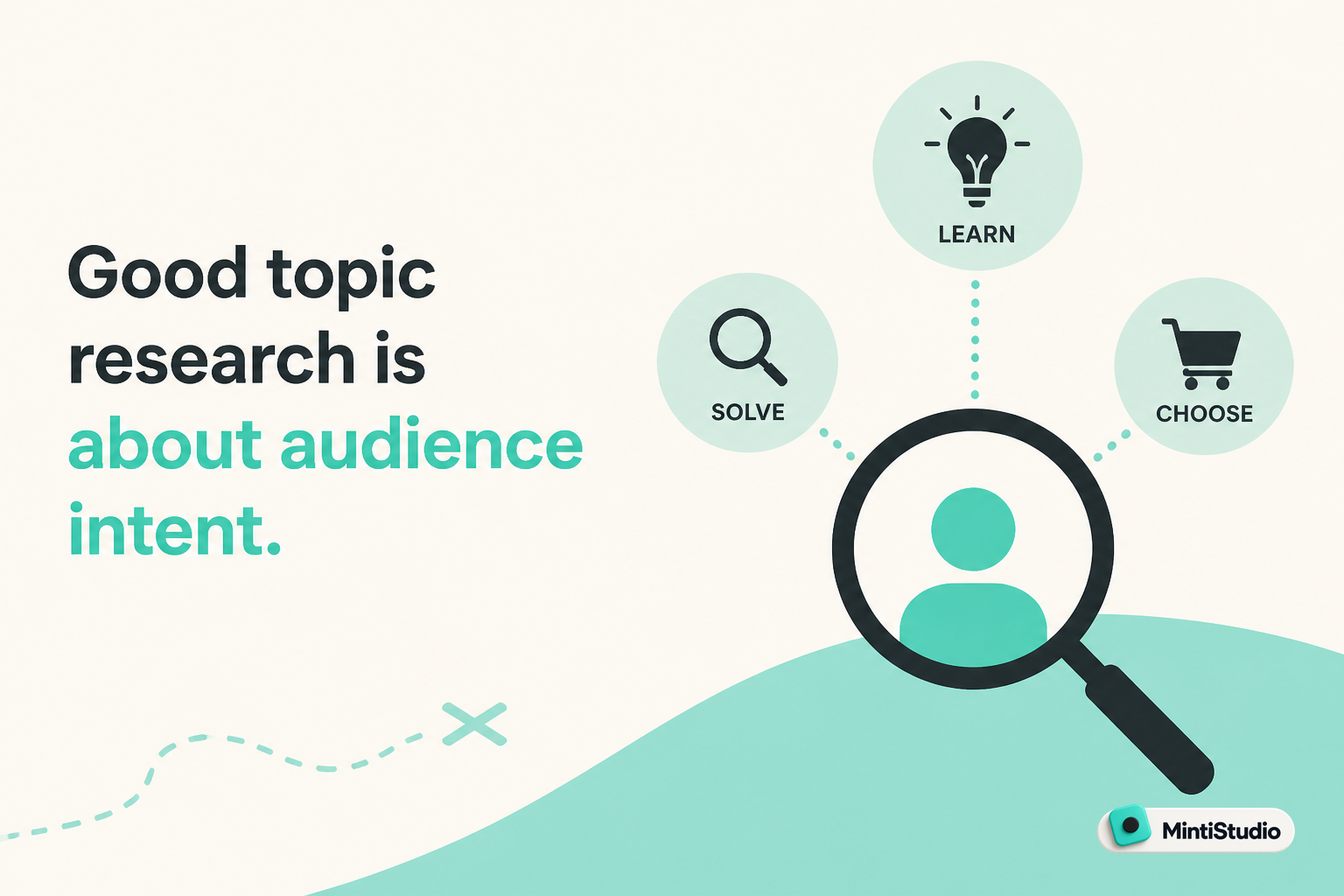
Good topic research is about audience intent
You do not need a giant strategy document to do this well. You need to understand why someone is watching.
YouTube itself gives you the clue through Analytics and audience research tools. Those tools can help you review which videos get attention and which topics bring people into your channel.
That data is useful, but it works best when you read it through the lens of your offer.
A topic may bring in lots of viewers because it is broad. Another topic may bring in fewer viewers but more relevant ones. For a service business, the second topic can be the better business choice.
Look for problem-based topics
Problem-based topics tend to attract better-fit viewers than curiosity-based topics.
For example, instead of leaning on a generic “what I ate today” format, a nutrition coach could frame content around:
- why certain food choices make meals harder to sustain
- how to read common food patterns without overcomplicating them
- what to look for when reviewing meals through a nutrition lens
- how to build habits around eating instead of chasing perfect choices
Those topics still have plenty of room for personality, but they also point toward a clear professional angle.
What happens when topics miss the offer
A mismatched topic strategy usually creates one of four problems:
- the channel attracts viewers who like the topic but do not need the offer
- the comments focus on entertainment instead of transformation
- the audience learns your personality but not your value
- the content performs, yet the business side stays flat
That does not mean the content failed. It means it served a different goal.
This is why “more views” is not always the same as “better audience.”
Signs your topics are too broad
You may be drifting too broad if:
- viewers ask for content that is outside your offer
- your strongest videos are the least connected to what you sell
- people remember the topic but not the problem you solve
- your best-performing posts do not lead to qualified conversations
When that happens, the fix is usually not to post more. It is to tighten the topic.
Build topics that point toward your expertise
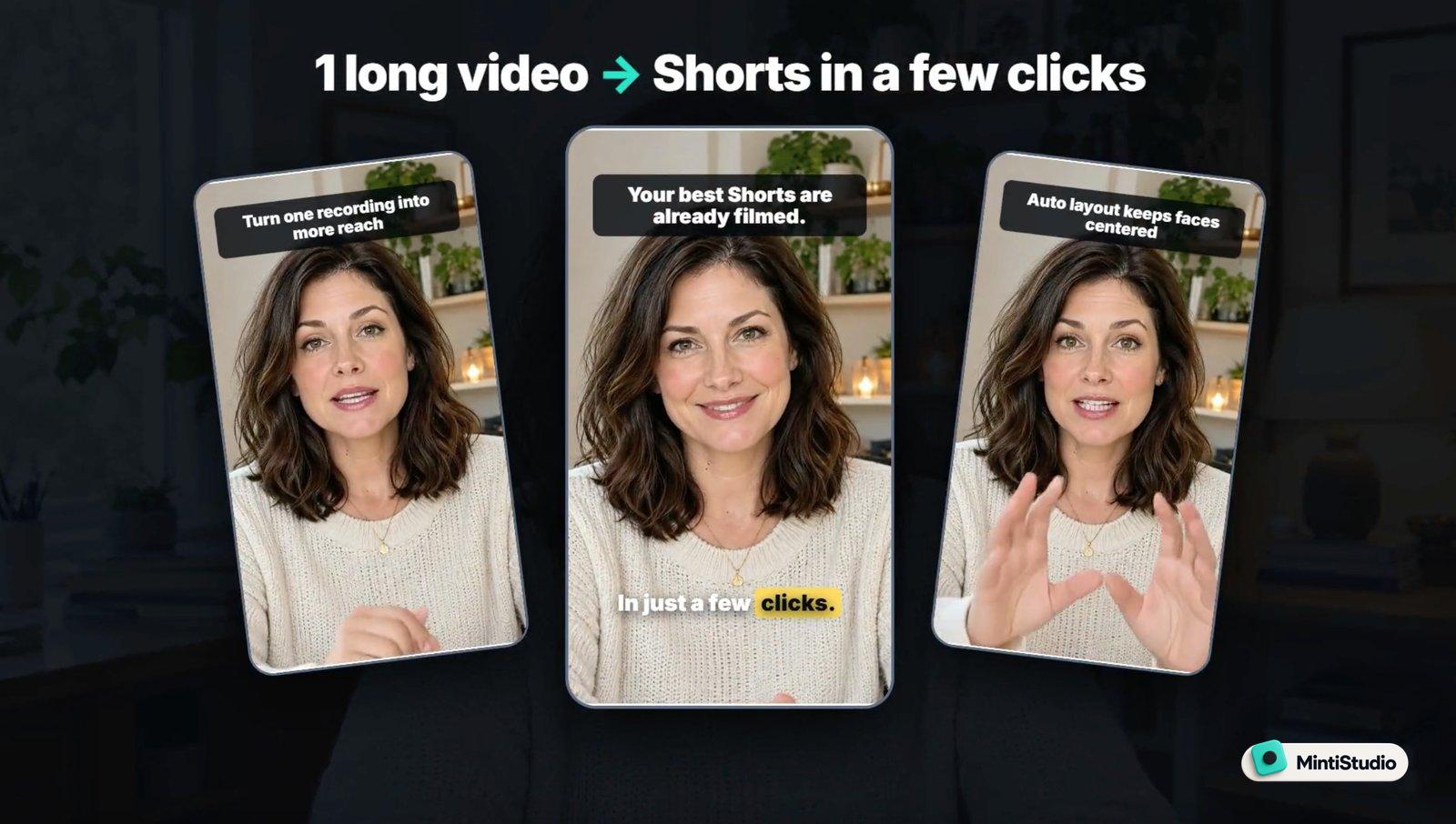
You do not have to abandon interesting content. You just need to frame it so it supports your expertise.
That means changing the angle, not necessarily the subject.
A fitness coach can talk about a grocery store, a meal, or a habit check-in. A consultant can talk about a case study, a common mistake, or a client question. A teacher can talk about a lesson, an example, or a recurring confusion point.
The subject may be broad. The framing makes it relevant.
Ask what your topic proves
Every topic communicates something about your expertise.
Ask whether the viewer will learn that you help with:
- making a decision
- understanding a process
- solving a specific problem
- avoiding a common mistake
- getting a result they care about
If the answer is unclear, the topic may be too loose to support your offer.
A good topic does not only attract attention. It gives the right viewer a reason to trust your judgment.
How to test topic fit before you commit to a series
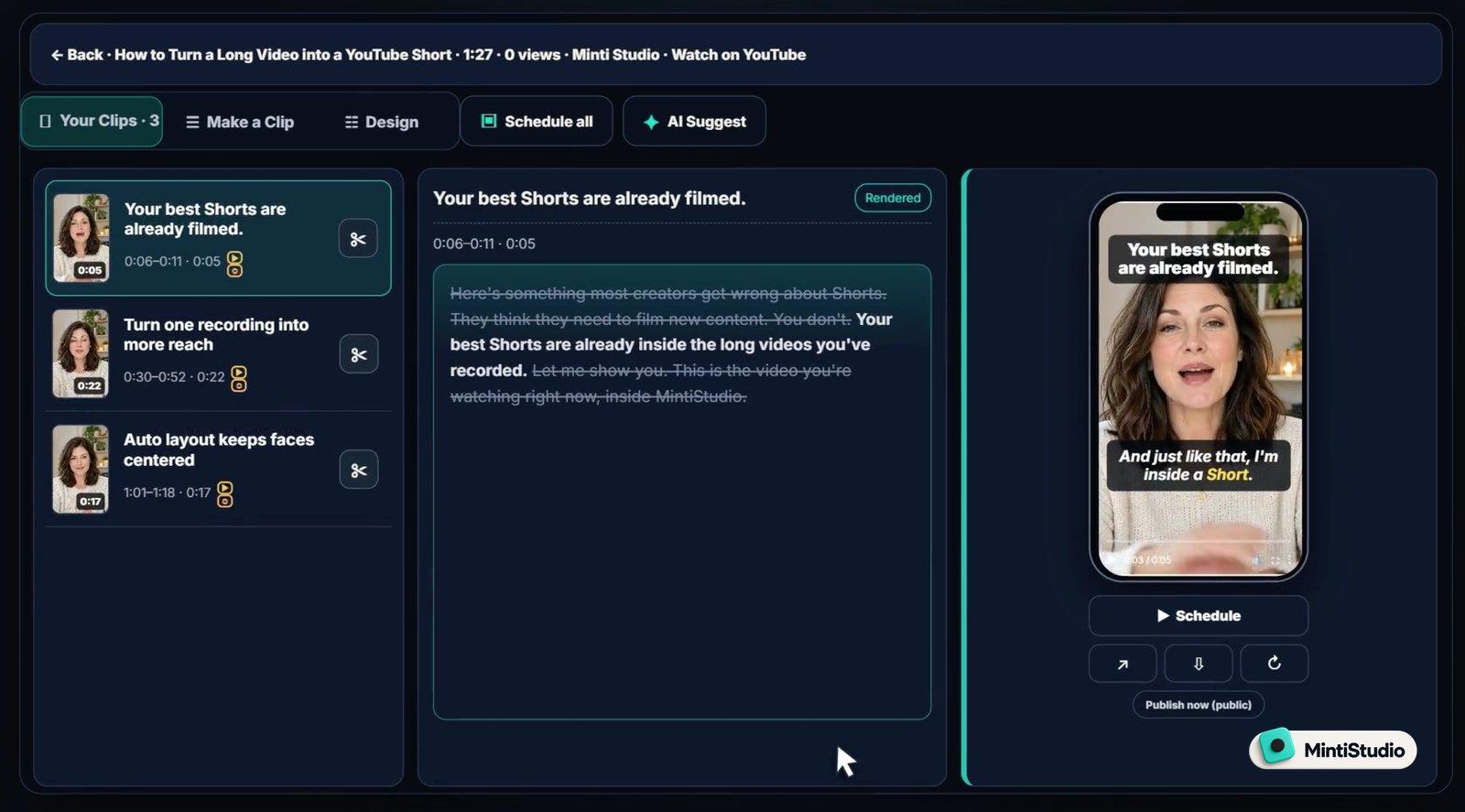 Screenshot from Minti Studio
You do not need to guess blindly. You can test a topic with a small batch of content.
Start with one long video or one clear teaching session. Then slice it into a few Shorts around the same core problem. Watch how the audience responds.
If the comments, saves, and follows reflect the people you want to serve, you have a strong direction. If the response feels generic, the topic may need a sharper angle.
A simple test loop
Use this sequence:
- pick one topic tied to your paid offer
- publish one long teaching video on that topic
- turn the strongest moments into Shorts
- compare the response from the Shorts with the response from broader topics
- keep the angles that attract the right kind of viewer
This gives you a practical way to learn without rebuilding your channel from scratch.
Where Minti Studio helps
Minti Studio helps when the topic is right and you want to turn that long-form teaching into Shorts without adding more editing work.
If you already have a recording, you can paste a YouTube link or upload a file, then use AI clip suggestions and transcript-based selection to find the moments that express your expertise clearly. That makes it easier to turn one aligned lesson into several Shorts that still point to the same offer.
If your source video is horizontal, Minti Studio can reframe it to vertical so the same teaching fits Shorts and Reels. Caption style templates help keep the message readable, and scheduling lets you publish the clips in a steady rhythm instead of all at once.
Autopilot fits when you want the long-video-to-Shorts workflow handled for you. You share your YouTube channel link, and Minti Studio prepares the clips, captions, titles, and publishing setup while you review every prepared Short before anything goes out. That is a good fit when your real bottleneck is time, not ideas.
A simple workflow for better topic alignment
You do not need a complicated content system. You need a repeatable one.
Define the buyer problem
Write down the one problem your paid offer solves most clearly. Use plain language, not category jargon.
Choose one topic angle
Pick a topic that makes that problem obvious to a viewer who has it.
Publish one teaching asset
Record one lesson, breakdown, or discussion that stays close to the problem.
Repurpose the best moments
Turn the strongest sections into Shorts that reinforce the same audience fit.
Review the response
Watch who comments, who clicks, and which questions show up again. Keep the angles that attract the right people.
What to ignore at first
Do not let raw views be the only signal.
A topic that gets attention from the wrong people can distract you from a better fit. If the goal is to support an offer, the better question is whether the video is helping the right viewer move closer to buying.
A practical example of better topic framing
Imagine a nutrition coach who wants to attract clients looking for weight-loss support.
A broad food-review topic might draw viewers who are mainly chasing deals, novelty, or general entertainment.
A better-framed topic would still use food, but it would teach the viewer how to think about food in a way that matches the offer. The content might compare meal choices, explain how to evaluate a plate, or show how small habits affect consistency.
The difference is not just style. It is audience intention.
That same idea applies to coaches, educators, and consultants in other fields. Your topic should make the right viewer feel seen before they ever reach your offer page.
Related guides
- How Coaches Can Turn Long Videos into Shorts That Bring in Clients
- Help Buyers Find Your Expertise Before They Know Your Name
- Your YouTube Audience Watches but Doesn’t Buy: Find the Gap Before Changing Your Price
The practical next step
If your current topics bring in attention but not the right kind of attention, narrow the angle before you change your whole channel.
Start with one offer-aligned topic, publish one strong teaching video, and turn it into Shorts that keep the same audience in mind.
Start free with Minti Studio and turn your best teaching into Shorts that speak to the people your offer can actually help.
More from the blog
How Busy Doctors Can Grow a YouTube Channel in One Hour a Week
A practical weekly workflow for doctors who want a steady YouTube channel without turning content into a second job.
YouTube Shorts for Doctors: The Complete Guide
A practical guide for doctors and clinicians who want to use YouTube Shorts for education without turning content into a second job. Learn how to choose safe, useful topics, keep the tone professional, build a simple workflow, and use Minti Studio when your real bottleneck is turning recorded expertise into publishable Shorts.