How Coaches Can Turn Long Videos into Shorts That Bring in Clients
Coaches already record hours of great material in sessions, webinars, and Q&As. Learn how to turn those long videos into focused Shorts that reach the right clients — without recording something new every day.
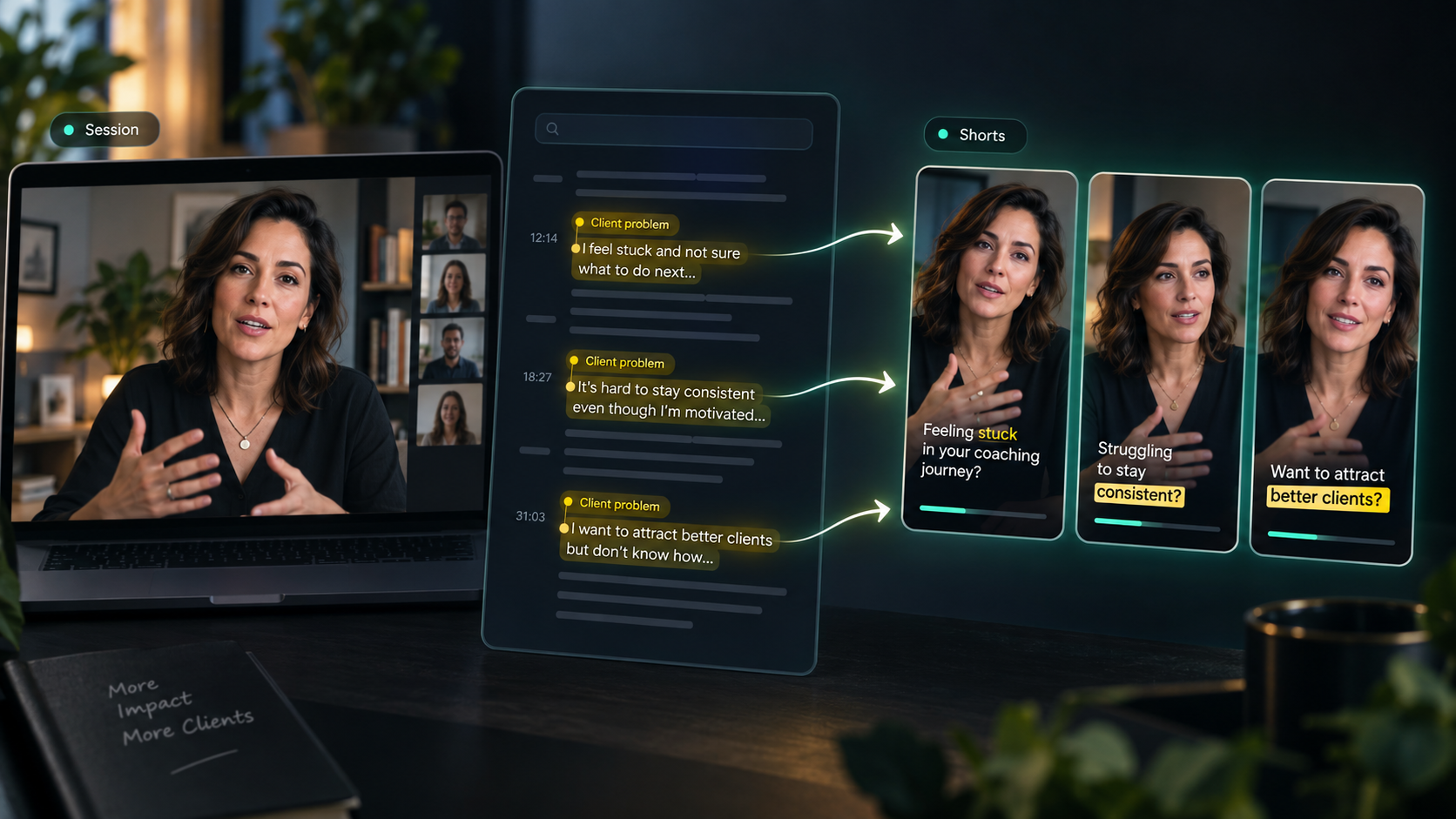
Your best coaching content is already recorded. It just needs a smaller doorway.
Start free with MintiStudio
Coaches already create the perfect source material for Shorts
If you coach, you are already producing long-form content every week.
Client sessions, group calls, webinars, workshops, live Q&As, and training replays are full of moments where you explain something clearly, correct a common mistake, or reframe how someone thinks about their problem.
That is exactly the kind of material Shorts are built for.
The issue is rarely that you have nothing to say. The issue is that your best thinking is buried inside a 60-minute recording that a new potential client will never sit through.
A Short gives that person a smaller way in. It lets them hear one useful idea from you before deciding whether they want to work with you.
A coaching Short should show how you think
The easiest mistake is to treat a Short like a highlight reel — a punchy line with no substance behind it.
For coaches, that usually backfires.
People do not hire you because you sound confident for ten seconds. They hire you because the way you think about their problem feels different and useful.
So a strong coaching Short should show a small piece of your actual thinking.

Before choosing a clip, ask:
- Does this moment solve or reframe one real problem?
- Would my ideal client recognize themselves in it?
- Can someone understand it without the full session?
- Does it start with the problem, not the setup?
- Does it make them curious about working with me?
You are not just cutting time. You are choosing the moment that best represents how you help people.
Start with the transcript, not the recording
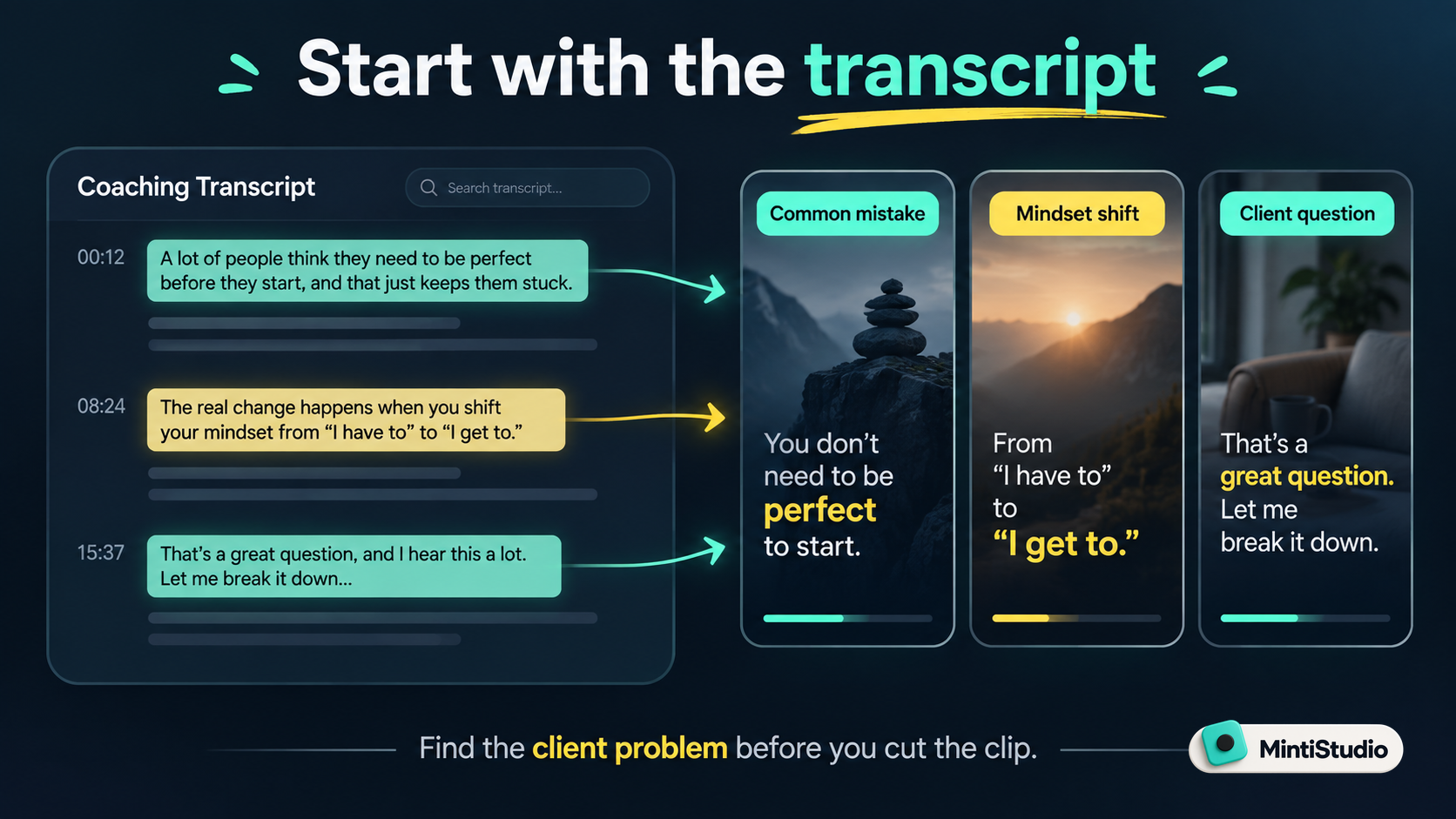
Most coaches try to find clips by re-watching the whole call.
That works, but it is slow, and it is uncomfortable to watch yourself for an hour.
A transcript is faster. You can scan the conversation, search for the moments where you gave a clear answer, and spot the ideas you keep coming back to.
Look for moments like:
- a common mistake your clients make
- a mindset shift you help people through
- a simple framework you use again and again
- a clear answer to a question you get all the time
- a short story about a client result (kept anonymous)
- a strong, quotable belief you hold about your work
These are the moments that make a new viewer think, "this person understands my situation."
We wrote more about finding these moments in Video Clipping for Creators: How to Turn Long Videos into a Weekly Shorts Engine.
Build each Short around one client problem
Coaching conversations move through many topics.
That is fine in a full session, but confusing in a Short.
For short-form clips, each video should focus on one problem your client actually has.
Instead of clipping a section that touches three ideas, pick the strongest one and build the Short around it.
A focused Short is easier to title, easier to understand, and easier for the right person to remember.
A good clip usually answers one question:
- Why do you keep starting over instead of staying consistent?
- What is the real reason you feel stuck?
- What should you focus on first?
- What mistake is quietly costing you progress?
- What would change if you thought about this differently?
If the clip answers one clear question your ideal client is already asking, it has a much better chance of reaching them.
Open with the problem, not the intro
The first few seconds decide everything.
In the Shorts feed, nobody searched for you. Your clip simply appears while someone is scrolling.
That means you cannot open the way you would open a session:
"So, great question, let me back up a little and give some context..."
That makes sense live, but it is weak as a standalone Short.
Start where the value starts:
"Most people don't have a motivation problem. They have a clarity problem."
That sentence names the problem and gives the viewer a reason to stay.
You do not need to be dramatic. You just need to begin where your insight begins.
Captions make your expertise easy to follow
For coaches, captions matter more than most people expect.
Many viewers watch without sound. Others are in a noisy place. Some simply follow ideas better when they can read along.
Your visual is often just you talking, so captions carry a lot of the weight.
A few practical rules:
- Keep lines short.
- Make the text large enough for mobile.
- Highlight only the key words.
- Avoid covering your face.
- Use enough contrast to stay readable.
The goal is not decoration. The goal is to make your thinking easy to follow in a few seconds.
You still stay in control of what represents you. We covered that balance in AI Can Suggest Your Clips. You Should Still Decide Which Ones Go Out..
Write titles that name the problem you solve
A coaching clip usually needs a little context.
The viewer may not know who you are or why the moment matters, so the title has to do some work.
Skip vague titles like:
"Some coaching advice"
Use something that names the problem:
"Why You Keep Losing Motivation Halfway Through"
Or:
"The Real Reason You Feel Stuck (It's Not Discipline)"
The title does not need to be clever. It needs to make the right person feel seen.
One session becomes a week of Shorts
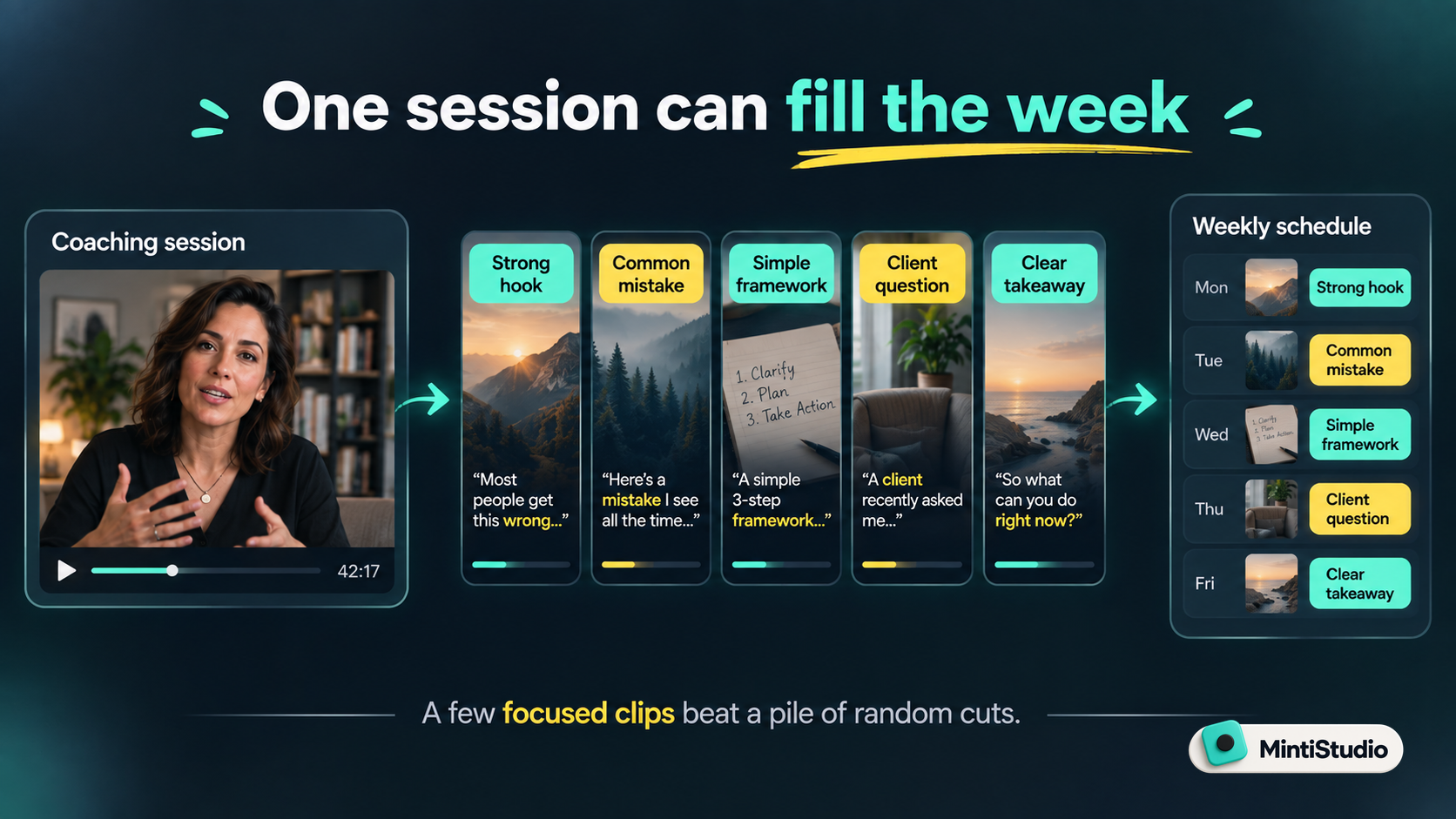
One long recording should not become a single Short.
If the conversation was good, you can usually pull several focused clips from it.
For example, one workshop might become:
- one clip with your strongest belief or hook
- one clip that names a common mistake
- one clip with a simple framework
- one clip that answers a frequent client question
- one clip with a short, anonymous client story
- one clip that invites people to work with you
This is where coaching content becomes efficient.
You already did the hard part by showing up and teaching. Shorts help you get far more reach from the same hour.
We explored this repurposing idea in How to Repurpose Long Videos into Short Clips.
Let Shorts be the doorway, not the whole pitch
Shorts work best for coaches as discovery, not as the entire funnel.
A stranger sees one clear moment. They understand how you think. They get a small sample of your approach.
Then they might watch more, follow you, join your list, or reach out about working together.
That is the healthy role for Shorts.
They introduce your thinking. Your deeper work — sessions, programs, and long-form content — builds the trust that leads to clients.
We made this case in Shorts Are Not the Whole Strategy. They Are the Entry Point..
Schedule clips instead of posting them all at once
After making several Shorts, it is tempting to publish them all in one day.
Usually it is better to spread them across the week.
This gives each clip room to be seen and keeps your presence steady without recording something new every day.
A simple weekly rhythm works well:
- Record or use one long session.
- Create three to five Shorts from it.
- Schedule them across the next several days.
- Watch which problems get the strongest response.
- Use that signal when choosing clips from your next session.
We wrote more about this in The Weekly Shorts Workflow for Busy Creators and Should You Publish All Your YouTube Shorts at Once?.
Where MintiStudio helps
Turning sessions into Shorts sounds simple, but as a coach your time is already spoken for.
You would need to find the strong moments, trim them cleanly, add captions, write titles and descriptions, schedule everything, publish it, and learn from the results — every single week.
MintiStudio helps carry that operational load.
You can start from a long recording, review AI-suggested moments, create vertical clips, add readable captions, prepare your publishing details, and schedule the Shorts across your channels.
It does not replace your judgment. You still decide which moments represent your coaching.
MintiStudio just makes it realistic to keep the system running while you focus on your clients.
A simple coach's workflow
Here is a practical workflow you can use:
- Choose one strong session, webinar, or Q&A.
- Review the transcript instead of re-watching the whole thing.
- Pick three to five moments that solve one clear problem each.
- Make sure each clip opens with the problem.
- Add readable captions.
- Write a title that names the problem you solve.
- Schedule the clips across the week.
- Track which problems and hooks resonate most.
You do not need to turn every minute into content.
Start with the moments that best show how you help people.
A few focused Shorts will always beat a pile of random clips.
Next step
Choose one recent session and find three moments where you solved a real problem for someone.
Then turn those moments into captioned Shorts and schedule them across the week.
Related guides
- How to Make Shorts from Podcast Episodes
- How to Repurpose Long Videos into Short Clips
- The Weekly Shorts Workflow for Busy Creators
- Shorts Are Not the Whole Strategy. They Are the Entry Point.
Start free with MintiStudio
More from the blog
YouTube Shorts for Consultants: A Practical Workflow for Public Proof Without Sharing Client Confidentials
Consultants often have strong expertise locked inside private calls, workshops, and explainers. This guide shows how to turn those long recordings into buyer-relevant Shorts that build public proof, while keeping confidential details out of the workflow.
Turn Prospect Objections into Your Next Teaching Video
Use the questions prospects ask on sales calls to plan teaching videos that answer real objections, show your thinking, and create standalone moments that can become Shorts. This guide gives coaches and consultants a simple way to turn one conversation topic into a useful long video and a set of clip-ready lessons.