How to Make Shorts from Podcast Episodes
Podcast episodes are full of short-form moments. Learn how to turn long conversations into focused, captioned Shorts without losing the original context.
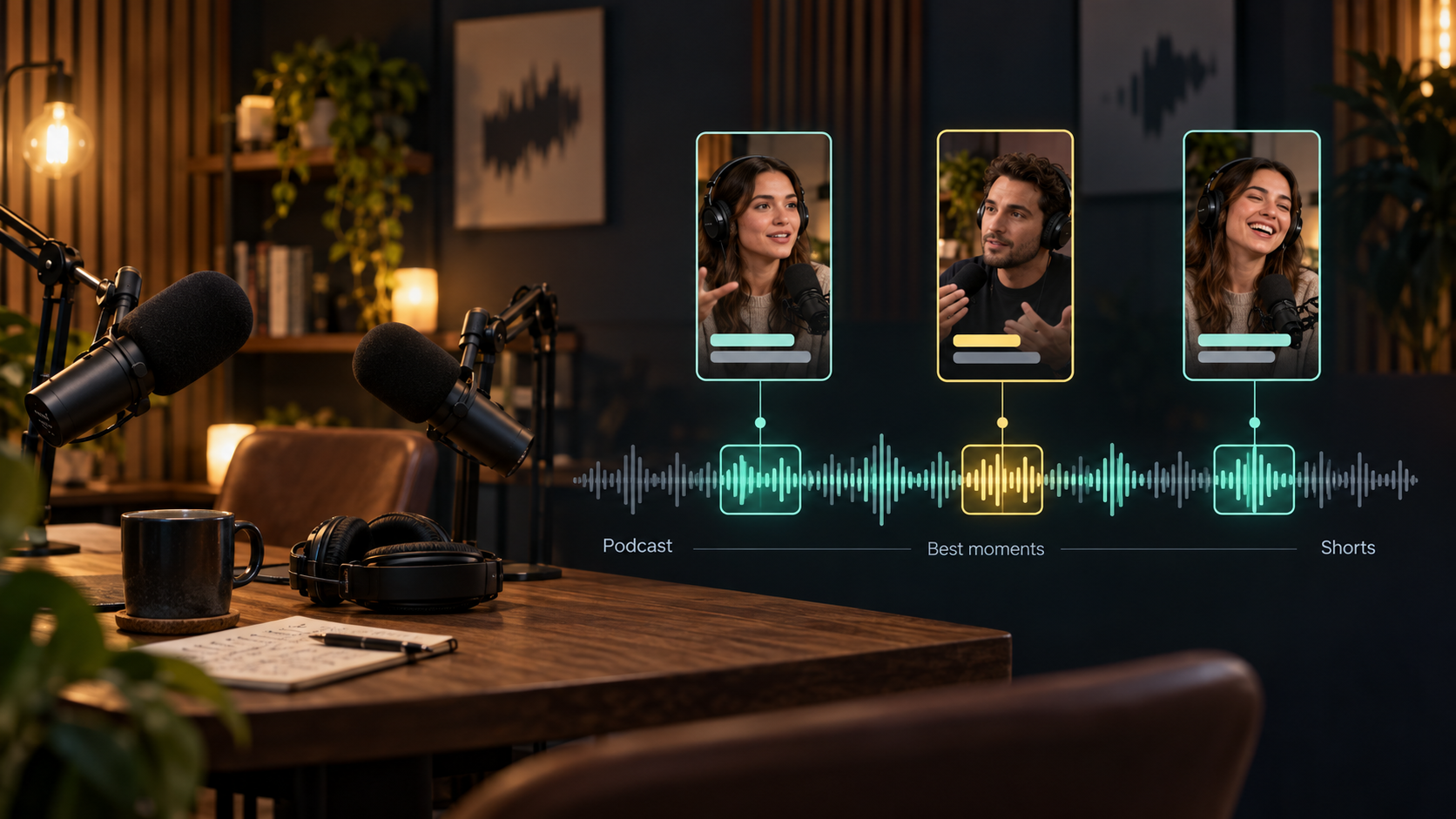
Podcast episodes are full of short-form moments.
Start free with MintiStudio
Podcast episodes are already built for short-form content
A good podcast episode usually contains more than one idea.
There may be a strong answer, a surprising story, a clear explanation, a practical lesson, a funny moment, or a sentence that makes people stop and think.
That is why podcast episodes can work so well as Shorts.
The problem is not usually a lack of content. The problem is finding the right moments, keeping them focused, adding readable captions, and publishing them consistently.
A full podcast episode may be 30, 60, or 90 minutes long. Most people will not start there if they have never heard of you before. A Short gives them a smaller entry point.
It lets a new viewer hear one useful moment before deciding whether they want the full conversation.
A Short should not feel like a random cut
The easiest mistake is to take any 30 seconds from the episode and call it a Short.
That usually feels unfinished.
A strong podcast Short should feel like a small complete idea. It does not need to explain the entire episode, but it should make sense on its own.
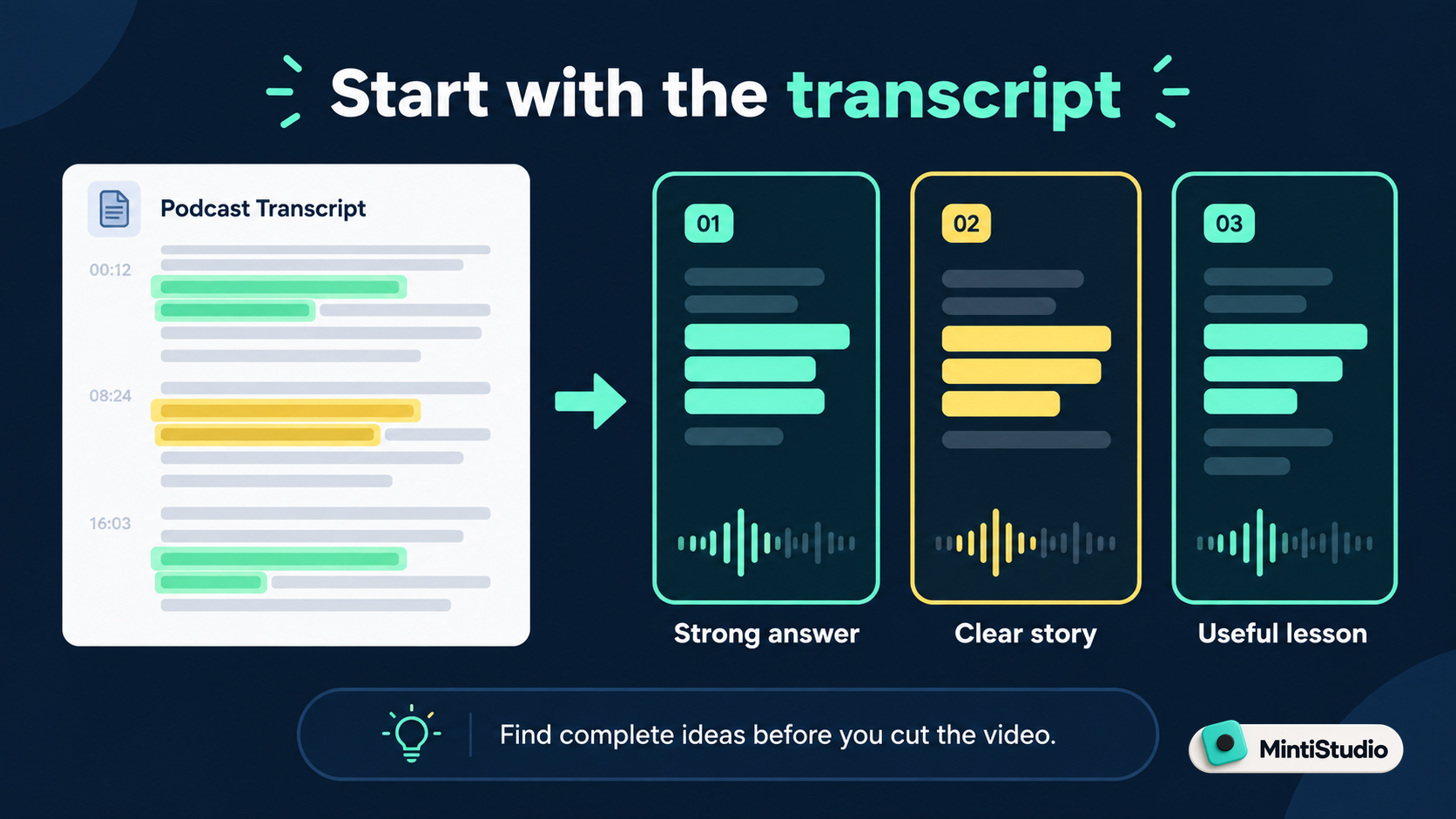
Before choosing a clip, ask:
- Does this moment have one clear point?
- Can a new viewer understand it without the full episode?
- Does it start quickly?
- Does it end in a clean place?
- Would this moment make someone curious about the full conversation?
The best Shorts often come from moments where the speaker is already clear, emotional, practical, or surprising.
You are not just cutting time. You are choosing the part of the conversation that can stand alone.
Start with the transcript, not the timeline
Podcast creators often try to find clips by scrubbing through the video timeline.
That works, but it is slow.
A transcript makes the process much easier. You can scan the conversation, search for strong phrases, find repeated themes, and notice where the speaker gives a complete answer.
Look for moments like:
- a strong opinion
- a short story
- a useful framework
- a mistake people commonly make
- a surprising lesson
- a clear answer to a common question
- a sentence that sounds like a hook
This is why transcripts matter so much in a Shorts workflow. They help you see the structure of the conversation instead of guessing from the video timeline.
We wrote more about this in Video Clipping for Creators: How to Turn Long Videos into a Weekly Shorts Engine.
Choose clips around one idea
Podcast conversations can move quickly from one topic to another.
That is natural in the full episode, but it can be confusing in a Short.
For short-form clips, each video should usually focus on one idea.
For example, instead of clipping a section that includes three different points, choose the strongest one and build the Short around that.
A focused Short is easier to title, easier to caption, easier to understand, and easier for viewers to remember.
A good clip might answer one question:
- Why do creators struggle to post consistently?
- What makes a podcast moment worth clipping?
- How should someone think about Shorts?
- What mistake should beginners avoid?
- What is one lesson from this conversation?
If the clip answers one clear question, it has a better chance of working.
Protect the first few seconds
The beginning of a podcast clip is very important.
In the Shorts feed, people did not search for your episode. Your clip appears in front of them while they are scrolling.
That means the first few seconds need to be clear.
A podcast Short should not begin with a slow intro like:
“Yeah, exactly, and that reminds me of something...”
That may make sense inside the full conversation, but it is weak as a standalone Short.
A better opening starts closer to the actual idea:
“Most creators do not have a content problem. They have a consistency problem.”
That sentence gives the viewer a reason to keep watching.
This does not mean every Short needs to be dramatic. It just means the clip should begin where the value begins.
Add captions people can follow
Captions are not only for accessibility. They also make short-form videos easier to watch in real life.
Many people watch Shorts without sound at first. Others are in a noisy place. Some viewers simply understand better when they can read along.
For podcast clips, captions are especially important because the visual may be simple: one or two people speaking.
Good captions help the clip feel more active.
A few practical caption rules:
- Keep lines short.
- Make the text large enough for mobile.
- Highlight only the most important words.
- Avoid covering the speaker’s face.
- Use contrast so the text is readable.
- Do not make every word feel loud.
The goal is not to decorate the video. The goal is to help people follow the idea.
Write a title that gives context
A podcast clip often needs a little context.
The viewer may not know who is speaking, what the episode is about, or why the moment matters.
That is why the title matters.
A good title helps the viewer understand the promise of the clip before or while they watch it.
Instead of a vague title like:
“Great podcast moment”
Use something more specific:
“Why Creators Struggle to Stay Consistent”
Or:
“How One Podcast Episode Can Become a Week of Shorts”
The title does not need to be long. It just needs to make the topic clear.
Turn one episode into several Shorts
One podcast episode should not become only one Short.
If the conversation is strong, you may be able to create several focused clips from it.
For example, one episode might become:
- one clip with the strongest hook
- one clip with a practical lesson
- one clip with a personal story
- one clip with a common mistake
- one clip with a useful framework
- one clip that points people to the full episode
This is where podcast content becomes powerful.
You already did the hard work of recording the conversation. Shorts help you get more value from that same episode.
We also covered this broader workflow in How to Repurpose Long Videos into Short Clips.
Schedule clips instead of posting everything at once
After creating several Shorts, it can be tempting to publish them all immediately.
Usually, a better approach is to spread them across the week.
This gives each clip more space and helps your channel stay active without needing to record something new every day.
For many creators, a simple weekly rhythm works well:
- Publish the full podcast episode.
- Create three to five Shorts from the episode.
- Schedule those Shorts across the next several days.
- Watch which topics get the best response.
- Use that feedback when choosing clips from the next episode.
This turns podcast publishing into a repeatable system.
We wrote more about this in The Weekly Shorts Workflow for Busy Creators and Should You Publish All Your YouTube Shorts at Once?.
Use Shorts as the entry point to the full episode
Shorts should not always be treated as the whole strategy.
For podcasts, Shorts often work best as discovery.
A viewer sees one strong moment. They understand your style. They get a sample of the conversation. Then they may choose to watch the full episode, subscribe, visit your channel, or follow more of your work.
That is the healthier role for Shorts.
They introduce the conversation.
The full episode builds the relationship.
This is especially important for educators, coaches, consultants, faith-based creators, interviewers, and subject-matter experts. Your deeper value usually lives in the longer conversation. Shorts help more people find the doorway.
We explored this strategy in Shorts Are Not the Whole Strategy. They Are the Entry Point..
Where MintiStudio helps
Turning podcast episodes into Shorts sounds simple, but the weekly work can become heavy.
You need to find strong moments, trim them cleanly, add captions, prepare titles and descriptions, schedule the clips, publish them, and learn from the results.
MintiStudio helps make that workflow easier.
You can start from a long podcast episode, review AI-suggested moments, create vertical clips, add readable captions, prepare publishing details, and schedule the Shorts across your channels.
The point is not to replace your judgment.
You still decide which moments represent your show.
MintiStudio helps with the operational work so your podcast can become a steady short-form publishing system.
A simple podcast-to-Shorts workflow
Here is a practical workflow you can use:
- Choose one strong podcast episode.
- Review the transcript.
- Pick three to five moments that stand on their own.
- Make sure each clip starts quickly.
- Add readable captions.
- Write a clear title and short description.
- Schedule the clips across the week.
- Track which topics and hooks perform best.
You do not need to turn every sentence into content.
Start with the best moments.
A few focused Shorts are better than many random clips.
Next step
Choose one podcast episode and find three moments that could help a new viewer understand the value of the full conversation.
Then turn those moments into captioned Shorts and schedule them across the week.
Related guides
- How to Turn YouTube Videos into Shorts
- How to Repurpose Long Videos into Short Clips
- The Weekly Shorts Workflow for Busy Creators
- Shorts Are Not the Whole Strategy. They Are the Entry Point.
Start free with MintiStudio
More from the blog
YouTube Shorts for Consultants: A Practical Workflow for Public Proof Without Sharing Client Confidentials
Consultants often have strong expertise locked inside private calls, workshops, and explainers. This guide shows how to turn those long recordings into buyer-relevant Shorts that build public proof, while keeping confidential details out of the workflow.
Turn Prospect Objections into Your Next Teaching Video
Use the questions prospects ask on sales calls to plan teaching videos that answer real objections, show your thinking, and create standalone moments that can become Shorts. This guide gives coaches and consultants a simple way to turn one conversation topic into a useful long video and a set of clip-ready lessons.