How to Validate a Coaching Offer on YouTube Before Leaving Your Job
A practical guide for employed professionals who want to test a coaching or consulting offer on YouTube before they quit their job. Learn how to publish a small set of useful lessons, read comments and viewer questions for demand signals, and use Minti Studio to turn long recordings into Shorts without adding another editing job to your week.
A good offer test is not about going viral. It is about hearing the right problems from the right people.
If you are thinking about starting a coaching or consulting business with YouTube, the real question is not whether you can make videos.
It is whether your expertise solves a problem people care enough to discuss, return to, and eventually pay to solve.
That is a much better validation target than views alone. A channel can get attention for all kinds of reasons. An offer becomes real when viewers keep asking for the same kind of help, the same clarification, or the next step.
This guide shows a low-risk way to test that demand while you still have a job. You will use a small set of substantive videos, watch for useful audience signals, and keep the process sustainable enough to repeat.
What you are actually validating
You are not trying to prove that YouTube can replace your salary immediately.
You are checking whether three things line up:
- people have a problem you understand well
- they recognize your content as relevant to that problem
- they respond in a way that suggests a paid offer would make sense
That distinction matters.
A lot of people confuse interest with validation. Interest can look like views, likes, or a friendly comment. Validation looks more like a viewer describing a pain point you can solve, asking how to work with you, or returning for more specific guidance.
Start with one problem, not one business idea
Before you record anything, choose one problem that your experience makes you qualified to explain.
The best starting point is usually not a giant promise like “I help people build confidence.” It is something more concrete, such as:
- how to prepare for a difficult presentation
- how to price a service without undercharging
- how to move from manager to independent expert
- how to structure a coaching session that actually leads to action
A clear problem makes your content easier to judge.
If your topic is too broad, every comment is noisy. If it is too narrow, you may get attention but not enough signal. You want a problem specific enough to attract the right viewer and broad enough to recur in different videos.
Use your work history as the source of proof
You do not need to invent a niche from scratch.
Your job experience already contains practical knowledge, repeated questions, and lessons you have learned the hard way. Those are useful because they are anchored in reality.
A consultant might draw from internal process changes, client onboarding, or recurring sales objections. A coach might draw from habit change, accountability, or confidence in difficult conversations. A subject-matter expert might draw from project management, operations, leadership, or a specialized toolset.
The point is to start where your expertise is already strongest.
What good validation signals look like
When a channel is helping you test an offer, the best signals are usually small and specific.
Look for these patterns:
- viewers ask follow-up questions that go deeper than the video topic
- commenters describe the same pain in their own words
- people mention they are trying to solve the problem now
- you hear “how do I do this for my situation?”
- the same kind of question shows up across multiple videos
Those are stronger than broad praise.
A comment like “great video” is nice. A comment like “I am stuck on pricing my first package because my clients keep asking for custom work” tells you much more about demand.
You are listening for repeated friction, not applause.
Build a tiny offer test around three lessons
You do not need a full content machine to validate an offer.
Start with three videos that each answer one part of the same problem.
A simple structure could look like this:
- Video one: define the problem in plain language
- Video two: show the most common mistake
- Video three: explain the first practical step
That sequence helps you see whether viewers want the topic in general, whether they understand the obstacle, and whether they are ready for more specific help.
If you want to keep the process manageable, treat each video as a test of one idea rather than a performance piece.
A helpful planning question
Before recording, ask:
What would a serious viewer need to understand before they would trust me with this problem?
That question keeps you focused on usefulness instead of polish.
Where Minti Studio helps
Minti Studio helps when your best material already lives inside long recordings and you want that footage to keep working without creating another evening editing job.
You can paste a YouTube link or upload a file, then turn the strongest parts into Shorts that introduce your expertise to new viewers. That makes it easier to test demand because one long lesson can produce several short entry points instead of one isolated upload.
Autopilot is the done-for-you path when you have recordings but no time to run a clipping workflow yourself. You share your YouTube channel link, and Minti Studio handles clip selection, vertical reframing, captions, titles, and scheduling prep. You still review every prepared Short before it goes out, so your public messaging stays aligned with the offer you are testing.
That matters when your goal is validation, not content busywork.
A simple workflow for validating your offer
A steady workflow is usually better than a burst of random uploads.
Step one: choose one recurring problem
Pick a problem that comes up more than once in your world.
If you have been hearing the same concern from colleagues, clients, or teammates, that is a good sign. If you have solved it more than once in your own work, that is even better.
Do not choose a topic just because it sounds smart. Choose one that people already struggle to explain.
Step two: make one video answer one question
Each video should do one job.
That might mean explaining how the problem shows up, why common advice fails, or what a first workable approach looks like.
A video that tries to teach everything usually teaches less. A focused video is easier to evaluate because viewers can tell you what landed and what still feels incomplete.
Step three: use comments as research, not vanity metrics
Read the comments carefully.
You are not trying to count praise. You are trying to identify language.
Pay attention to the phrases people use when they describe their situation. Those phrases are often better than the words you would choose yourself. They can shape your next title, your next lesson, and eventually your offer language.
Step four: turn the strongest moments into Shorts
Once you have a long video, the most useful section can become a Short that reaches new people.
That is where Minti Studio fits well. Its AI clip suggestions can help you find likely highlight moments, and transcript-based selection makes it easier to pick a clean segment without scrubbing through the whole recording. If the video is horizontal, you can reframe it to vertical and prepare a Short that is ready for publishing.
The practical benefit is simple: you keep testing the same expertise across more entry points without turning editing into a second job.
Step five: watch for repeated themes over time
One comment is a clue.
A few similar comments can point to a pattern.
If the same concern shows up in different videos, you are probably close to a real offer.
If viewers ask for the next step, the template, the checklist, or the live example, that is a strong sign that the topic has commercial potential.
How to tell interest from demand
Not every positive response means your offer is ready.
A useful distinction is this:
- interest means people enjoy the topic
- demand means people need help applying it
You want both, but demand matters more.
A video about presentation confidence might get lots of views because it is relatable. That does not automatically mean viewers want coaching. A video about preparing for a high-stakes presentation and avoiding one specific mistake may attract fewer people, but they may be much closer to paying for help.
That is why it helps to look for questions that imply action.
Questions like these matter:
- What do I do first?
- How do I apply this to my situation?
- Can you show an example?
- How would this work if I have limited time?
- What should I avoid?
Those are the kinds of questions that can become the basis of an offer.
If viewers only respond to the big idea, keep refining the problem until they start asking for the process.
What to verify before you rely on any growth claim
If you start comparing monetization paths or audience-growth stories, keep validation separate from exceptional outcomes.
For YouTube Partner Program eligibility and current feature access, check YouTube Help directly before you make decisions based on thresholds or tier details. Those rules can change, and the official source matters more than creator recollection.
The same caution applies to earnings stories. If a creator shares a revenue breakdown or timeline, trace it back to the original disclosure, check whether it was shown in full context, and look for any notes about sponsorships, one-time wins, or unusual conditions. Treat the claim as one example, not a forecast.
For offer validation, the realistic signal is not that someone else earned a particular amount. The realistic signal is that your own content keeps attracting the right questions from the right viewers.
What to publish before you quit your job
Before you make a career move, you want enough evidence to reduce guesswork.
A simple benchmark is this:
- you can explain your audience problem clearly
- you have seen repeated questions around that problem
- at least one content format reliably attracts the right kind of attention
- your next step feels obvious enough to package into a service, coaching offer, course, or paid workshop
That does not mean everything is proven.
It means you have enough signal to keep going without treating a hope as a plan.
A practical content loop for busy professionals
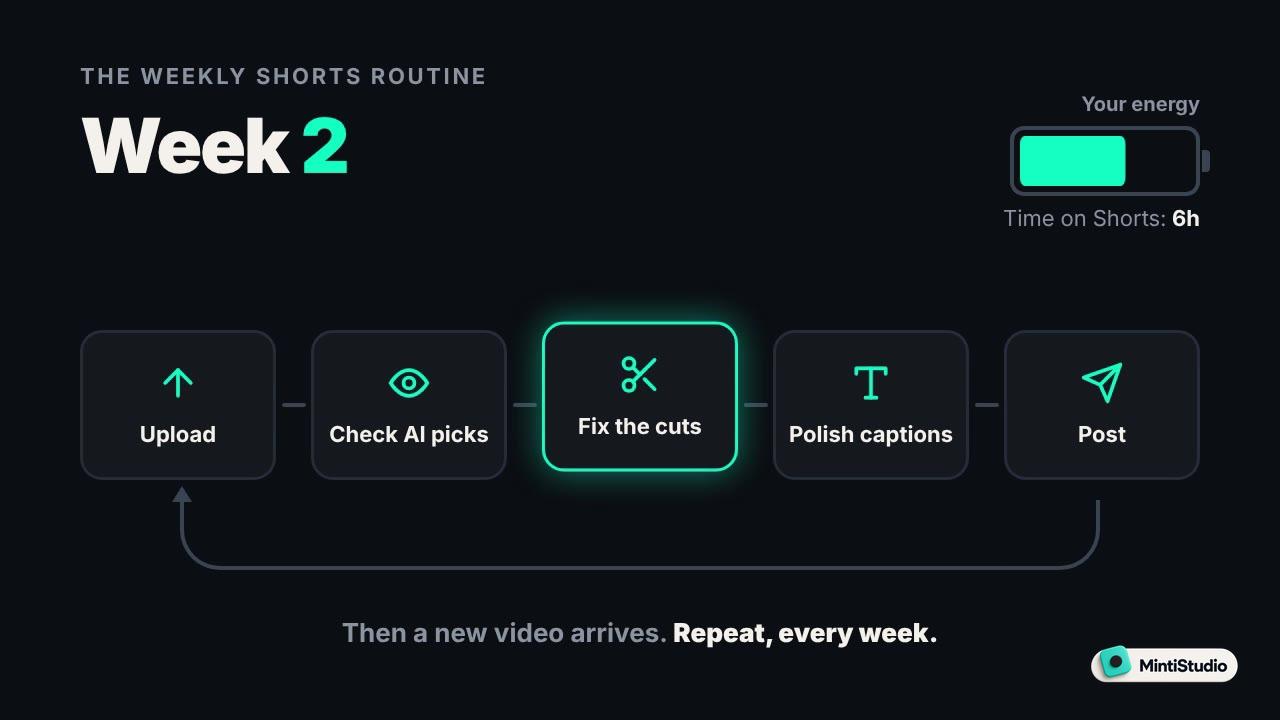
Most employed professionals do not have room for a full-time creator schedule.
You need a loop that stays light enough to maintain after work.
A manageable loop looks like this:
- record one helpful long lesson
- turn the best moment into a Short
- publish and watch the questions it triggers
- use that language to shape the next lesson
- repeat the cycle
That loop is useful because it turns audience feedback into offer design.
Where to keep your focus
When you are validating a coaching or consulting offer, you do not need to become a full-scale content operation.
You need a clear topic, a repeatable format, and enough audience response to tell you whether the problem is real.
That is why Minti Studio is a good fit when your bottleneck is time. It helps you convert long recordings into Shorts so your expertise keeps reaching new viewers while you stay focused on the actual offer.
If your main challenge is deciding what the audience cares about, the comments matter more than the view count. If your main challenge is getting more entry points from the videos you already make, the clipping workflow matters more than recording more content.
Related guides
- Your YouTube Audience Watches but Doesn’t Buy: Find the Gap Before Changing Your Price
- Turn Prospect Objections into Your Next Teaching Video
- Done-for-You vs DIY Video Clipping: Which Fits Your Week?
The next move
Pick one problem your experience can explain well, publish three focused lessons, and treat the comments as research.
If you want those lessons to keep working as Shorts without adding more editing to your week, Minti Studio can handle the clipping workflow while you keep your attention on the offer itself.
More from the blog
How Busy Doctors Can Grow a YouTube Channel in One Hour a Week
A practical weekly workflow for doctors who want a steady YouTube channel without turning content into a second job.
YouTube Shorts for Doctors: The Complete Guide
A practical guide for doctors and clinicians who want to use YouTube Shorts for education without turning content into a second job. Learn how to choose safe, useful topics, keep the tone professional, build a simple workflow, and use Minti Studio when your real bottleneck is turning recorded expertise into publishable Shorts.